
Evaluate the system.
Not just the specification.
From a compact ECU bench to an integrated lab workflow, the right choice depends on your application, interfaces, constraints, and future programs.
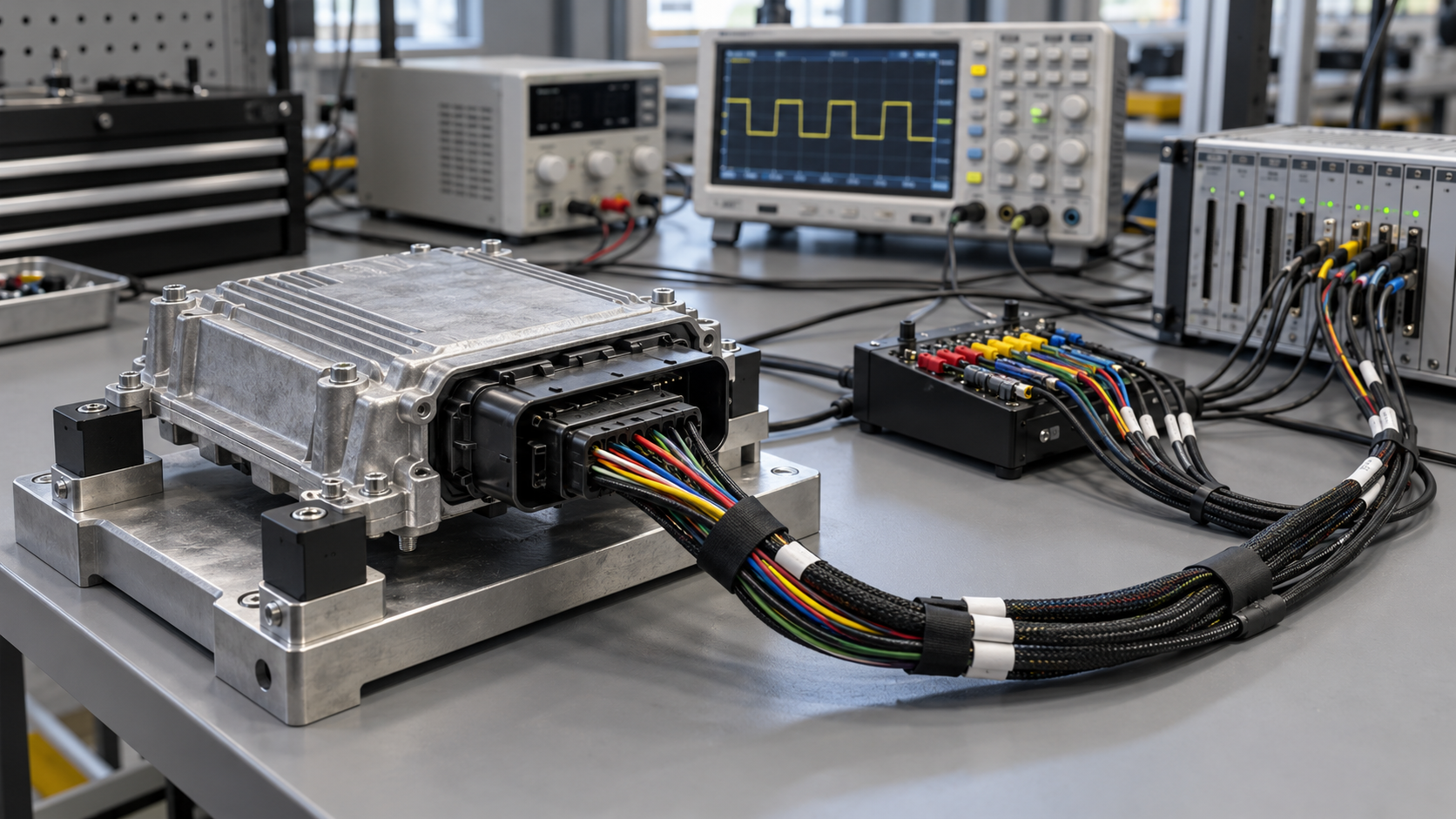
A HIL bench built
around your ECU.
Assess real-time compute, I/O, signal conditioning, network simulation, and the software needed to operate the bench together.
Discuss a HIL requirementQuestions to bring into the evaluation
- What loop timing and workload must the target meet?
- Which analog, digital, PWM, and bus interfaces are mandatory?
- What fault insertion and electrical protection are required?
- How will plant models, diagnostics, and test cases connect?
- Can the configuration expand without replacing the bench?
Software that fits
your engineering workflow.
Evaluate how a tool handles your data, models, test cases, and interfaces. Include licensing, automation, and the learning curve in the decision.
Evaluate a software toolSimulation & models
Plant modeling, real-time execution, SIL, and model exchange.
Test automation
Test authoring, orchestration, regression, and reporting.
Networks & diagnostics
Bus analysis, restbus simulation, diagnostics, and ECU access.
Measurement & calibration
Acquisition, analysis, calibration workflows, and data export.
Compatibility is
something to verify.
Interface support on a datasheet is a starting point. Check versions, options, and behavior using your own workflow.
Test interoperability
Where applicable, examine ASAM XIL support for connecting test automation and test benches.
ASAM XIL referenceModel portability
Where applicable, examine FMI model exchange or co-simulation support and the versions your toolchain needs.
FMI referenceCost over the lifecycle
Compare licenses, maintenance, training, integration effort, expansion, and dependencies alongside the purchase price.
Different programs.
Different priorities.
Application examples for scoping a conversation. Technical feasibility is assessed for each engagement.
Make your next tooling decision with clarity.
Bring your requirements, a shortlist, or simply the problem you need to solve.